Why Polaroids Fade — and Which Ones Are Dying Fastest
Polaroids fade because the developer chemistry that makes the image is sealed inside the print and never washed out, unlike a darkroom print — it stays faintly reactive for the rest of the print's life. Integral prints from the SX-70 and 600 era (1970s–80s) fade and yellow fastest; prints made before 1976 can also crack in the image-receiving layer. A yellowed print is usually a genuine repair; a crack is not — anything filling it back in is invented, not recovered.
Why do Polaroids fade in the first place?
An instant print starts fading the day it's made. Not from sunlight — though sunlight doesn't help. The chemistry that made the picture is still sealed inside it, and it never entirely stops.
Every other kind of photograph gets washed. This one doesn't. Almost everything about how instant film ages comes out of that one difference.
A darkroom print is developed in a bath, then washed. Whatever ran the reaction is rinsed away, and what's left is inert. An instant print is the opposite: rollers burst a pod of developing paste and spread it inside. Nothing washes it out.
How does the picture form, and does shaking a Polaroid actually help?
The picture is made by movement. Three dye developers — cyan, magenta, yellow — sit against the light-sensitive layers. Where light struck, the matching dye locks in place. Where it didn't, the dye travels up into the sheet you're looking at. Then it stops. Mostly.
This is where the shaking comes from. Peel-apart film dried in open air, so waving it helped. Integral film — the square prints most people own — develops behind a sealed window and never touches air. Nothing is drying. Polaroid said as much in 2004, after a pop song told everyone otherwise.
What damages a Polaroid after it's developed?
After development, three things work on the print slowly. Light — instant film has poor light-fading stability, worse than almost any other process. Heat. And the residue of its own chemistry, still inside, still faintly reactive, for the rest of the print's life.
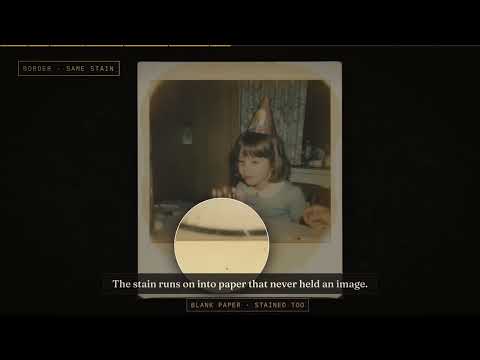
You can see that last one from across the room. Look at the white border — blank paper that never carried a picture. On a badly aged print it's stained too. The yellow doesn't stop at the edge of the photograph. The print is staining itself, from the inside.
Which Polaroids are fading and cracking the fastest?
So which are dying fastest? Integral prints from the seventies and eighties — the SX-70 and 600 era. Those are the ones conservators single out for yellow staining and fading.
Prints made before nineteen seventy-six carry a second problem: cracking, in the image-receiving layer under the cover sheet. And a crack isn't what it looks like. Not dirt on the surface, not a scratch in the coating — a fracture inside the print. Humidity swings open them.
What's the difference between a faded Polaroid and a cracked one?
Which leaves the only question that matters. Fading is a shift in something still present — the dye is dimmed and skewed, but it's there, and moving it back is repair. A crack is an absence. Nothing survives in that line. Whatever appears there afterwards was invented.
So a yellowed print really is recoverable. Modern tools — EditThisPic is ours — read what survived and pull the balance back. The dress and the frosting come back because both were still measurable under the cast, dimmed rather than erased. None of it is a guess.
The same tools on the cracked print do something else. The fracture disappears — but nothing was recovered. The fabric now crossing that line is a guess, generated to fill a gap. That may be fine for a print you only want to look at. It is no longer a record.
How should I store Polaroids to slow this down?
Storage matters more here than for any other photograph, because the print is still chemically live. Flat, cool, dark, dry, and out of the attic and the garage. Use enclosures that pass the photographic activity test — unbuffered ones. Then look at what you have. Yellowing is recoverable. A crack is part of the object now.
Repair vs. reconstruction, on this photo
RepairThe cast lifts. What was under it was always there.
ReconstructionThe crack is covered, not recovered. What filled it was invented.
Frequently Asked Questions
Sources
- Instant film forms its image by dye diffusion transfer: exposed dye is immobilised, unexposed dye diffuses to the image-receiving layer Springer — Imaging Processes and Materials
- The developer reagent is burst from a pod and spread by rollers, then sealed inside the print rather than washed out Upcycled Classic
- Shaking only helped older peel-apart film; integral film develops behind a sealed window and never touches air — Polaroid's 2004 statement on shaking causing separation or 'blobs' CNN
- Integral instant prints (notably SX-70, 1970s–80s) are especially prone to yellowish staining and fading; prints made before 1976 may crack in the image-receiving layer; poor light-fading stability and humidity-linked cracking; storage in nonbuffered enclosures passing the Photographic Activity Test Preservation Self-Assessment Program, University of Illinois
- Residual development chemistry remains in the print and continues to affect its aging; instant prints are not archival Margot Note
See If Your Polaroid's Color Is Recoverable
If it's yellowed rather than cracked, EditThisPic can pull the balance back — free to try, no signup required.
Restore your photo →